I Asked Every Claude Model for a Game
As a youngster I wanted to make games and stopped at the unknowns; now every new Claude model gets the same request, and in about four weeks of building a Hanseatic trading game with Fable 5 I never found its limit.
I always wanted to be a game developer. Design the game you love, then play it.
As a youngster I tried, more than once. But there were too many gaps to fill: graphics, sound, game experience. It wasn’t a lack of talent as a developer. It was the frustration. Every unknown took days to figure out, there were hardly any tutorials, and in the end the time had to go to school, and later to my studies.
So the big ambitions stopped. I became a normal engineer, and my career went another way.
Until AI and a few simple prompts opened that route in my life again.
Since then I have a habit. Whenever Anthropic releases a new model, I ask it to build me a game.
Sonnet 3.5: One Feature, Two Bugs
The first was a tower defense game for the browser. The graphics were minimalistic. The sound effects were an 8-bit catastrophe.
It didn’t get very far. Every feature I asked for arrived with two new bugs. It wrote tests, but they didn’t do their job.
The lesson stayed: a game needs a good, testable setup before it needs features.
And as bad as it was, it got further than I ever did as a youngster.
Opus 4.6 or 4.7: A City Builder With a Crew
In May 2026 I tested a new Opus release. 4.6 or 4.7, I’m honestly not sure which anymore. This time I didn’t ask one agent for a game. I gave the game a team.
Loopolis is a SimCity-style city builder in C# and Godot 4. One agent designed each feature, one wrote the simulation and its tests, one built the Godot side, one balanced the numbers, one played the game and reported what felt wrong, and one reviewed it like a games magazine. The simulation runs headless, so the agents could play it without ever opening the editor.
218 of the 224 commits landed in under five days: power grids, road traffic, fires that burn buildings down, and, 47 hours after the first commit, a win screen. The README closes its list of systems with “1 025 tests · 0 failures”. It was a game you could play.
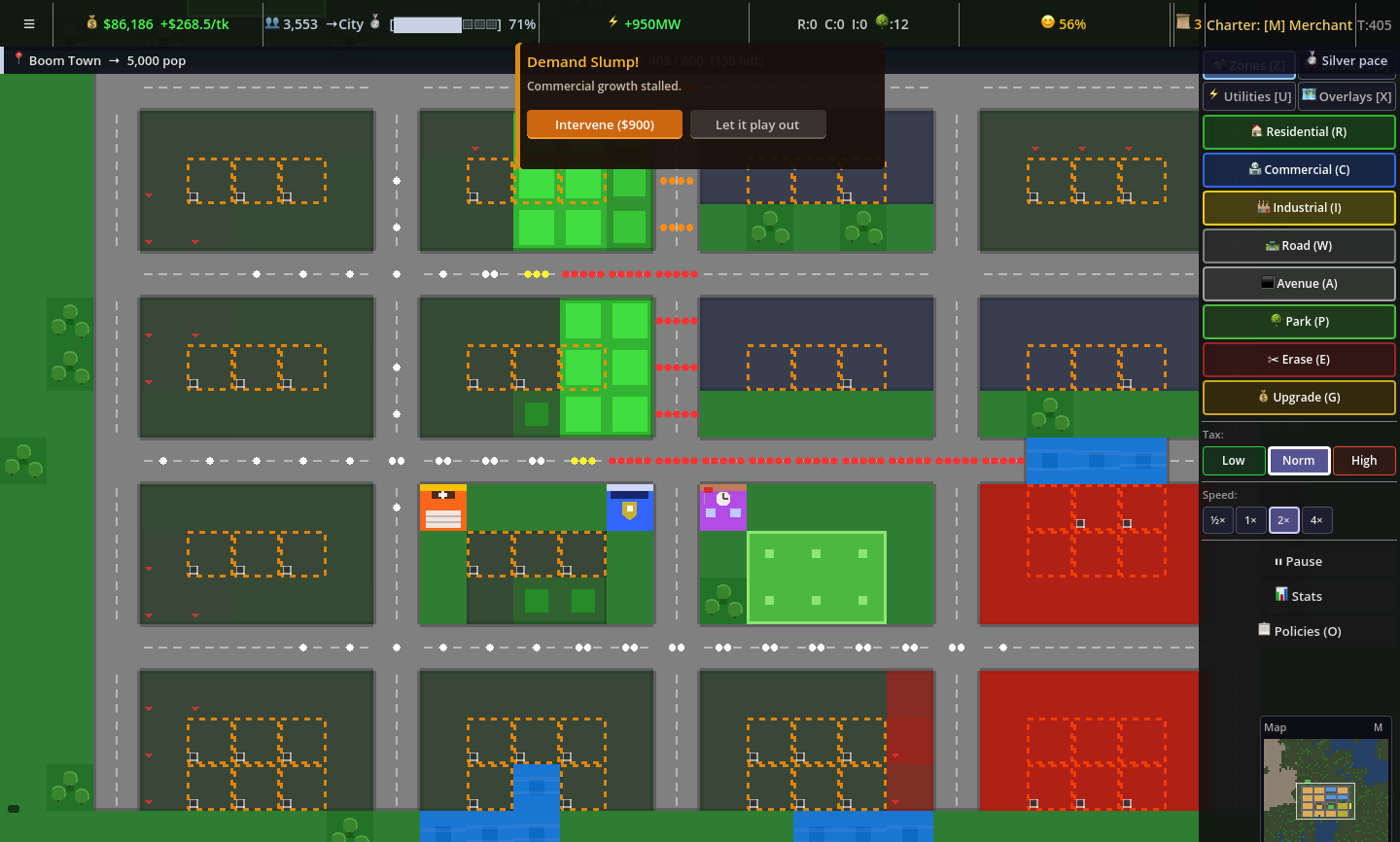
On 14 May the last feature landed. A week later a last round of commits got it ready for an open-source release, and then it went on the shelf.
Fable 5: Looking for the Limit
Then Fable 5 was released, and I wanted to test the limits once again.
The game this time was a Hanseatic trading sim in the spirit of Patrizier 2. Buy salt cheap in Lübeck, sail it to Danzig, sell it high, and grow from one leaky ship to a trading fleet, against rival houses that trade by the same rules you do. It started as Kontor. Today it is called Lastadie, after the loading quay and shipyard district of a Hanseatic town.
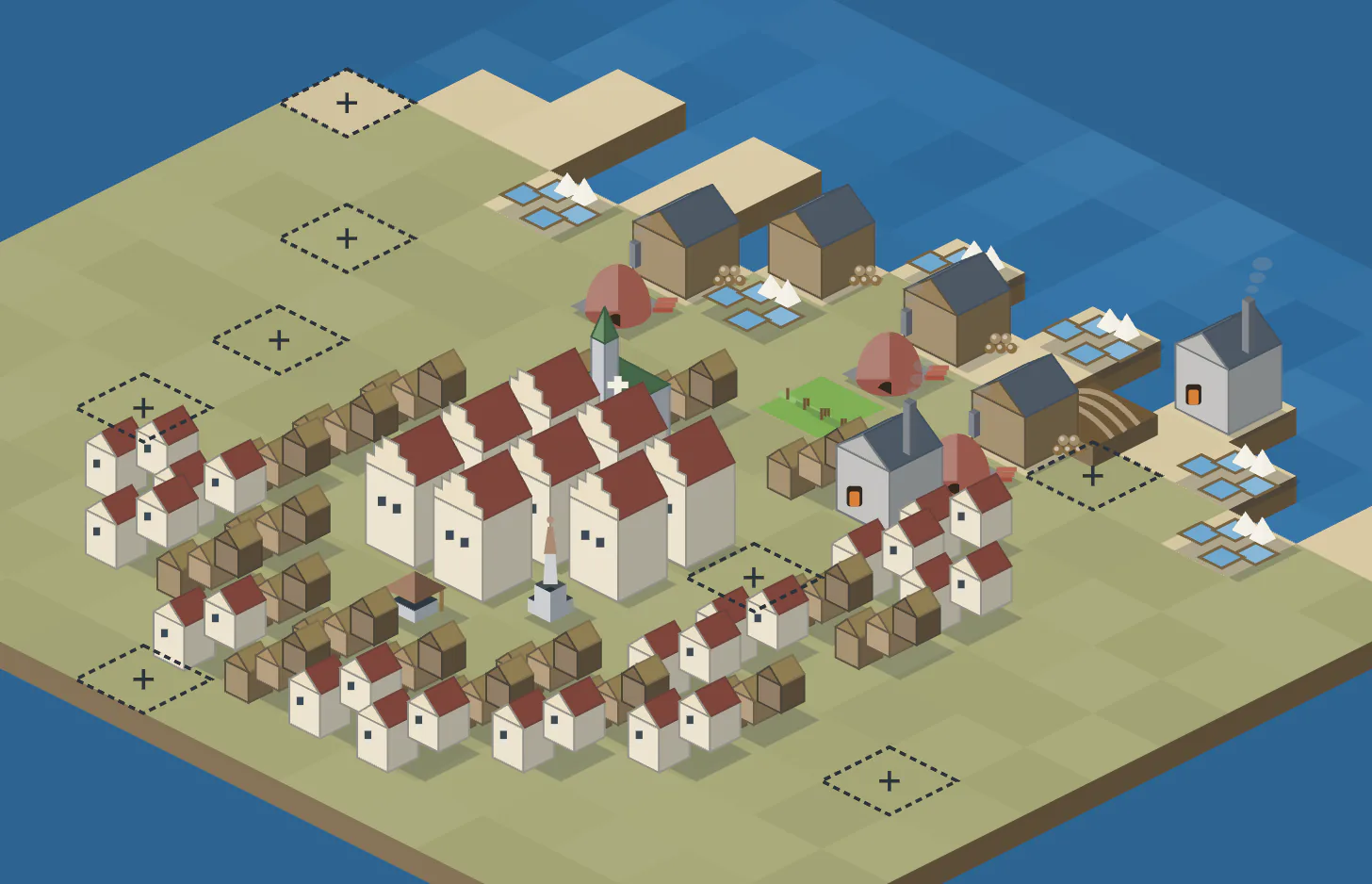
I ran Fable 5 on ultra mode, high effort. It used an absurd amount of tokens. But it could keep up with my game design ideas.
The first day shows what that means. The first commit, “seed repository”, landed on 7 August at 9:18 in the morning. Shortly after eleven, an agent played the first full loop: buy salt in Lübeck, sail to Danzig, sell at a profit. Later that day I looked at it and wrote back. Part of my feedback, verbatim:
“the map is too simple. it does not resemble the patricia and hanse guild back from 14th century at all”
At ten past eleven that night, the game had the real Baltic coastline.
I kept going until 8 September. When I stopped, the last release was 0.46.0, and the repository held 3,505 commits, about 121,000 lines of TypeScript for the game itself, and 6,687 unit tests. There are more lines of tests than lines of game. Sonnet 3.5 taught me how much a good, testable setup matters.
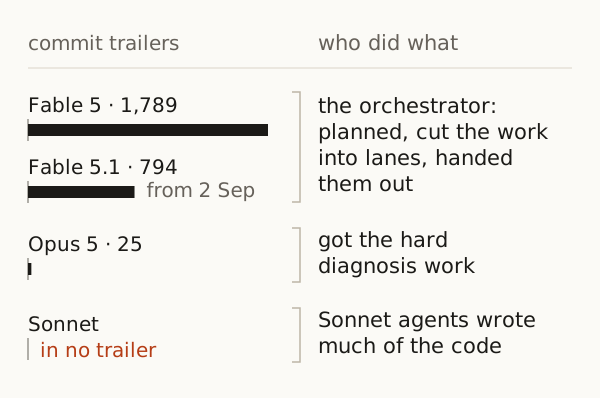
Not all of that was written by Fable itself. It was the orchestrator: it planned, cut the work into lanes and handed them out. Sonnet agents wrote much of the code, and Opus got the hard diagnosis work. The commit trailers don’t show that. They count Fable 5 on 1,789 commits, Fable 5.1 on 794 from 2 September on, and Opus 5 on 25. Sonnet doesn’t appear at all.
And “absurd” is not an exaggeration. The last big redesign wave before the release ran more than 60 agents and about 9.3 million tokens in subagents alone, all under one orchestrator.
You can play it in the browser. It even has its own soundtrack, generated locally on my machine, but that is a story for another post.
The Wall Moved
I worked on it for about four weeks and did not find a limit.
What got hard was the work around the model.
On day five, the instruction file every agent reads at the start of its work had grown to 518 KB. That evening it was cut to a 12.9 KB map at the root, plus one smaller file per part of the code, so an agent only reads the rules of the part it works in.
The tests became the next wall. Six property tests each generated and replayed their own copy of the same game session, just to check a single invariant. Together they took 1,271 seconds, more than 21 minutes. Sharing the session brought that down to 560.
And then there was the economy.
At the end of August, the late game had died, and my own rule had killed it: a hull at zero sinks at sea and is stuck in port. The rival houses could no longer keep their fleets, so they hardly got to the mayor’s seat anymore. I asked for a supply chain for repair materials. Nothing changed. I asked for new sources of fame. Nothing changed.
So I wrote down what I saw:
“this is the whole point of a trading game. Danzig is drowning in wood, Lübeck is starving […] the failure is missing trade between cities […] we have the need for hundreds of ships circulating wares […] yet not enough ships exists […] lets make ships more durable for now”
Ships wore out too fast, so there were never enough of them to carry the goods. The same evening, with hulls that wear from 100 to 80 over two years, the rival houses had fleets again and sat in the mayor’s seats again. In its journal, the orchestrator wrote that my reframing “was the diagnosis; my two mechanics before it treated symptoms.”
The orchestrator had traced the collapse to hull wear the night before, and it built both mechanics I asked for. Seeing that the shortage was the game, and that the ships were what failed, still took my eyes on the board.
Until You Try to Play It
In March I wrote about Anthropic’s harness experiment, in which a single agent asked for a retro game maker produced something that “looked like a game”, until you tried to play it. Their working version needed a team: a planner, a generator and an evaluator.
Both of my later games were built by teams too. Lastadie is my answer to “until you tried to play it”. Try to play it.
The Player Who Counts
The part that matters most has nothing to do with commits.
And at least my kid was stunned by a little game their dad could now create. In September I made a small game just for them. Now I can produce little games my kid can play, and they come back with wishes for what to change.
I never became a game developer. The gaps that stopped me as a youngster, the graphics, the sound, the days lost to every unknown, I no longer have to fill alone. What’s left is the part I wanted from the start: designing the game and playing it. Now someone plays it with me.