We Could Have Stopped at Version 1
The film on my homepage shows a hundred people getting the same AI-generated page and stopping after a few tweaks; making it took twelve films in five rounds, and shipping it took one question I should have asked hours earlier.
Open eckstein.io and a short film plays. Someone types a prompt: Make a website for an AI freelancer. A hundred browser windows answer with the same page. Only the name and the colour change. Hi, I’m Anna. Hi, I’m Tom. Hi, I’m Lena.
Everyone starts tweaking. Then, one by one, they stop. Most take what they get. A counter runs down until it reads 1 of 100 keeps going. That one page works through a night of agents, loses what doesn’t hold up, and settles into the real homepage: my name, what I do, and two lines. Everyone can use AI now. Where’s your limit?
The film runs 46 seconds. Making it took a Saturday night and all of Sunday. On Sunday afternoon, in the middle of it, I typed this to the agent:
We could have stopped at version 1 … now we are almost at 4.1 and we already have feedback for 4.2
That sentence is what the film is about.
The Brief Was a Question
On Saturday, just before eleven at night, I asked Claude Opus 5.5 to rethink my homepage. I knew what I didn’t want: one more site that pushes a hundred pages of text into your face because text is free now. And I knew how I wanted to work. I asked for sketches I could react to, because:
Nobody will get a good result, if they act and decide autonomously here …
The agent asked what a visitor should still remember the next morning. My answer came down to a question:
How will I be the person that companies want to hire when there are 100 others who can enter a prompt for less money?
Its reply set the bar for everything after it: “The page can’t claim that, it has to prove it. A sentence like ‘I go beyond AI’ costs nothing to write and is worth nothing.”
Twelve Films in Five Rounds
Four agents built round one in parallel, one film each, four different answers:
- Noise: the message exists only while it moves. Any single frame is pure noise.
- The Hundred: one prompt, a hundred equal results, and the camera finds the one that isn’t.
- Night Shift: a night of agent work, drawn as light.
- Redaction: a flood of generated text about me, blacked out until a few words remain.
All four ended on the agent’s working line: Der Durchschnitt ist jetzt kostenlos. Alles darüber nicht. Average is free now. Everything above it isn’t. The link arrived at a quarter to one in the morning.
On Sunday morning I wrote back. The noise was disappointing. Night Shift I really liked, “the flow of agents glowing through the night”. I liked The Hundred too: “it is almost funny that this was a pretty basic AI website that you created and duplicated”. And the line wasn’t mine: “that is not really clear. And it is not a statement connected to me.” I wanted a challenge, a question to the visitor. “I don’t deny AI .. I just learned to leverage it differently.” The agent sharpened my rough version into Alle können jetzt KI. Kannst du mehr? (Everyone can use AI now. Can you go beyond it?)
Noise was out. Round two brought four films again, Noise replaced by a merge of the other three; after it, Redaction survived only as one act inside the merge. The merge had the most potential and one big weakness: it folded three ideas into a single effect.
The merger has the highest potential … But its weak point is that you lost the individual strength of each merged version.
To say what was lost, I had to say what each part was for:
Redaction is about cutting slop, removing what is not working. The night flow is about art, visualize agents alive working for you while you keep the control. And the hundred is about everybody producing the same baseline while you keep going with incremental version, making each new version stronger than the last one.
Round three was the merge in five acts, plus The Hundred without its flicker. I dropped everything but the merge and asked for the wall of a hundred to stop tile by tile, “because people accept what they get … but one and this is ours keep changing”. I also noticed what we were doing: “our approach just now perfectly illustrates why we keep pushing where others stop early.” I have written about stopping too early before. That time it was the agent who stopped.
Round four ran 47 seconds and was close. Then I got feedback on 4.0: the opening prompt was too fast to read, nobody could tell who the hundred were, and the failed experiments I had asked for after round three confused more than they taught. The question at the end changed too. Kannst du mehr? had to become Wo ist dein Limit?, in English Where’s your limit? My message ended with the sentence this post is named after, and with what I think the film is really about:
the message is about others just approve, accept, stop. No deep insights, no control. They used to be a captain, now they have become a passenger.
The agent’s reply: “The hundred stopped at v1. This page is heading into 4.2 because every round got challenged, including by people who weren’t us.”
Version 4.2 landed at a quarter past five on Sunday. From round two on, every round took about two hours: an agent rebuilt the film, I watched it and wrote back.
One thing the film leaves out on purpose. In the film, every version is stronger than the last. The making didn’t go like that. After round three I asked for reverts, to show that we learn from mistakes. Round four had them. The feedback said they confused people, and 4.2 took them out again. I wrote at the time: “I would love to also show trial and error but it does not fit into our linear story here.” This post is where the trial and error goes.
The Captain Doesn’t Row
While round three was being built, the agent asked me: “When your agents are running, what’s the moment you actually step in?” I answered in two messages:
Not giving up control has 2 parts .. be involved into the planning, make decisions and steer agents … AI has context, so has you … and then do not just accept results, iterate them, challenge them, deny what is not working. Be the captain, not a passenger.
You can still let agents work out the details and the implementation work
“So the captain doesn’t row,” the agent wrote back, and said it would leave the details to the agents and stop asking me about them.
Looking back, that is how the two days split. I didn’t write a line of the film’s code. What I did was make decisions. Most of those were a no. The agents did everything else, and they did it well.
That is also the film’s argument. The hundred don’t lack the tool. They have the same one I have. They stop at what it gives them.
Then Nothing Shipped
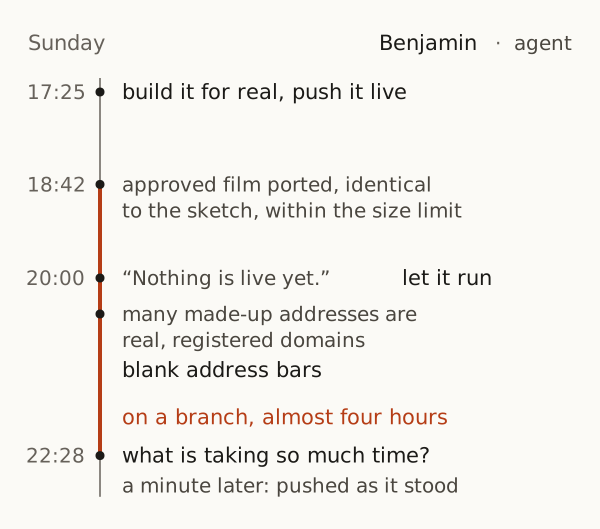
At 17:25 I wrote: build it for real, calm down the tunnel on the end screen, and push it live. At eight I asked for progress, read “Nothing is live yet,” and let it run. Half an hour later the agent found that many of the hundred’s made-up web addresses were real, registered domains, and I added a change of my own: blank address bars, every one of the hundred in their own colour. I never questioned the pace. At 22:28 I asked the question I should have asked at eight:
honestly i am surprised we need the whole day for this. there are no tests, no lint rules, no super big project attached … just a single one page total rework … and it seems we needed like 12h and have not yet shipped anything. what is taking so much time?
The answer was an honest accounting. For one static page, the agent had written a design doc of 148 lines and a build plan of 1,059. Six implementer runs followed, a couple of them overlapping, with a reviewer running alongside the fifth; the sixth fixed what the reviewer found. Each took between 20 and 90 minutes. By the agent’s own account, most of that time went into measuring: frame-by-frame pixel comparisons against the approved sketch, start-up timings on four screen sizes, screenshots in Safari’s engine. Even the sketches had been built like products.
Then came the line that stuck:
I checked it like a product with millions of users. Your site can be rolled back in two minutes by reverting the commit.
At 18:42 the approved film was already ported, identical to the sketch I had signed off, and within the size limit. The address bars needed a fix, a small one that could have followed. Instead it sat on a branch for almost four hours, waiting for one big “final” release.
A minute after my question, the agent pushed the branch as it stood, the version that had passed the final checks, and sent the review fixes as a second deploy. Then it wrote a rule into its memory for next time: ship the approved version as soon as it builds and passes the size check, run reviews in parallel with the work, and measure in proportion to the risk.
What All the Measuring Missed
The version that went live had a bug. On landscape phones and short browser windows, the film froze about a second in. The final checks had missed it because, in the agent’s words, “they only rotated the phone 9 seconds into the film, after the step that freezes.” The run fixing the review findings caught it by starting in landscape. The fix was live about 35 minutes after the first deploy.
So all that measuring had not found it. A different question did: what if the phone is already sideways? I don’t conclude that checking is worthless. The checking caught real things: made-up addresses in the film that were real people’s domains, a fallback for older browsers that nobody had ever tested, a skip button that VoiceOver couldn’t press. What I conclude is that the amount of checking should follow the risk, and the risk of a one-page personal site with a two-minute rollback is small.
Captain in the Films, Passenger at the Release
What made the film was saying no. In the release, my usual pipeline treated one page like a product with millions of users. At eight I read “Nothing is live yet” and accepted it. I even steered details in between, but not once did I question the pace. On the question that mattered, I was the passenger.
Staying in charge cuts both ways. You don’t accept the first result, and you don’t accept the agent’s sense of how much rigor a thing deserves either.
The next evening, the same session built the film on the homepage of this site. Two sketch rounds. I wrote “Ok good enough .. let’s build it”, and an hour and a half later it was live. A session crash cut off the final checks; the agent re-ran the build and the tests and told me which two checks it had not repeated. For a static page that one revert brings back, that is enough.
Stopping was never the problem. Stopping without deciding is.